11.4.1. Sustainable practices targets
Last Updated:
- English
- Türkçe
11.4.1. Sustainable practices targets
Middle East Technical University (METU) actively measures campus commuting patterns and enforces concrete institutional targets to transition towards sustainable, low-carbon transportation modes. Codified in the METU Strategic Plan 2023–2027 (Goal G4, Objective O4.2) and monitored daily via the digital METUPASS System, METU systematically reduces private vehicle dependence by expanding non-motorized transport networks (cycling and pedestrian paths), upgrading free campus shuttle/ring fleets, deploying Electric Vehicle (EV) charging infrastructure, and enforcing traffic-calming safety measures.
1. Empirical Commuting Monitoring & Vehicle Entry Tracking
METU routinely monitors daily traffic volume to limit carbon emissions and private vehicle density across campus roads:
- METUPASS Digital Monitoring (ktkb.metu.edu.tr/tr/odtupass): Automated campus entry gates systematically register vehicle access. As recorded in current empirical tracking logs, the average number of private cars entering the university campus daily is strictly monitored at 4,141 vehicles/day.
- Integrated Free Shuttle / Ring Network: To discourage private car usage inside campus, METU operates a comprehensive free shuttle bus (Ring) fleet coordinated with city public transit hubs (METRO stations), featuring designated shelter stops across all academic and residential zones.
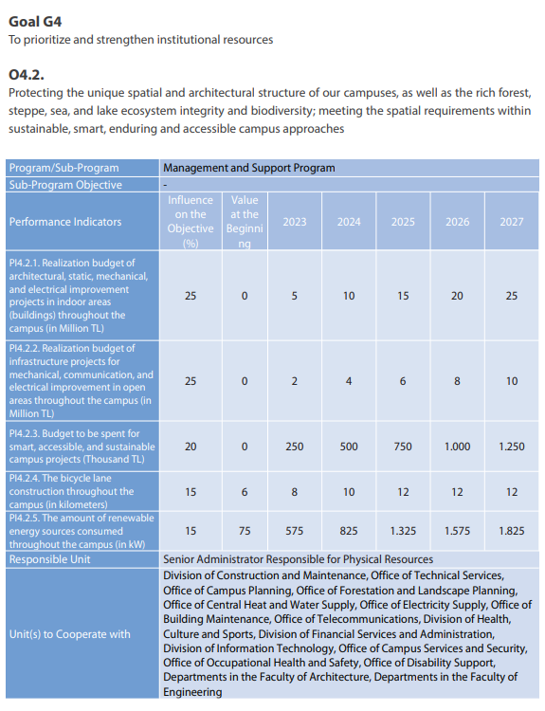
2. Strategic Plan 2023–2027: Target Cards & Financial Allocations (Goal G4 / Objective O4.2)
METU’s official Strategic Plan 2023–2027 establishes measurable performance indicators and strategic actions to strengthen institutional resources and meet spatial needs through sustainable, smart, resilient, and accessible campus approaches, while preserving the distinctive spatial and architectural character of its campuses, forest, steppe, sea, and lake ecosystems, and biodiversity. Under Goal G4 and Objective O4.2, the University aims to improve campus buildings and open-space infrastructure, increase investment in smart, accessible, and sustainable campus projects, expand the campus bicycle network, and increase renewable energy capacity. Specifically, the plan targets an increase in the length of campus bicycle paths from 6 km to 12 km by 2027 and an increase in renewable energy capacity from an initial 75 kW to 1,825 kW by 2027. These objectives are supported by measurable performance indicators and the collaboration of relevant institutional units. The objective is overseen by the Senior Manager Responsible for Physical Resources, in collaboration with units including the Department of Construction and Technical Affairs, Campus Planning, Landscaping, Administrative and Financial Affairs, Information Technologies, Barrier-Free METU, and relevant departments within the Faculties of Architecture and Engineering.
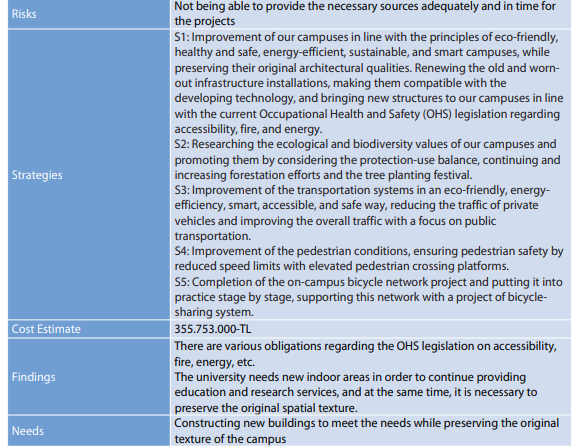
The Strategic Plan identifies the risk that the resources required for projects may not be provided in sufficient amounts or in a timely manner. To address this risk, METU’s strategies include improving campuses in line with environmentally friendly, healthy, safe, energy-efficient, sustainable, and smart campus principles; ensuring that new buildings comply with occupational health and safety regulations concerning accessibility, fire safety, and energy efficiency; and researching and promoting ecological and biodiversity values while maintaining a balance between conservation and use. The plan also prioritizes the development of smart, accessible, and environmentally friendly transportation systems, reducing private vehicle traffic in favor of public transport, improving pedestrian conditions and safety through measures such as elevated pedestrian crossings and lower speed limits, and completing the campus bicycle network in phases, supported by a bicycle-sharing system. Furthermore, the plan recognizes the need to comply with occupational health and safety legislation, provide additional indoor space to sustain educational and research activities, and preserve the campuses’ distinctive spatial character. Accordingly, the principal need is to construct new buildings that meet institutional requirements while safeguarding the architectural, spatial, and ecological integrity of the campus.
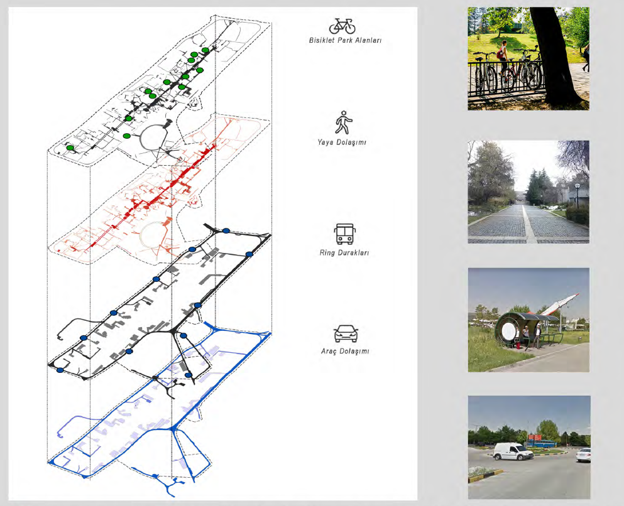
3. Spatial Infrastructure & Multimodal Mobility Mapping
METU’s physical campus layout is organized into 4 distinct spatial mobility layers to prioritize green modes over motorized traffic:
- Bicycle Network Layer: Dedicated bicycle lanes equipped with bike racks installed at key building entrances, faculty hubs, and dormitories.
- Pedestrian Circulation Layer: Continuous, safe, and traffic-calmed pedestrian walkways featuring elevated crossing platforms.
- Ring / Shuttle Transit Layer: Covered bus shelters placed strategically to maximize public shuttle efficiency and reduce internal car trips.
- EV Infrastructure & Fleet Renewal: On-campus Electric Vehicle (EV) charging stations have been installed to support zero-emission vehicles, alongside ongoing replacement of older ring buses with modern, energy-efficient models.