
14.3.3. Maintain ecosystems and their biodiversity (direct work)
Last Updated:
- English
- Türkçe
14.3.3. Maintain ecosystems and their biodiversity (direct work)
In 2025, METU worked directly to maintain and extend aquatic ecosystems and their biodiversity, especially threatened species and habitats.
Sea turtle monitoring (Mersin)
Each year, the METU Institute of Marine Sciences monitors and protects sea turtle nesting on the beaches near its Erdemli campus, and involves children in the work through its education programmes.
Lake Eymir and Lake Mogan
METU's Limnology Laboratory and EKOSAM run long-term ecological monitoring and restoration of Lakes Eymir and Mogan, including a biomanipulation programme to restore the lake ecosystem after decades of wastewater pollution.
EKOSAM also works to extend freshwater habitats. Ponds can hold up to 70% of a region's freshwater species and more of its rare, endemic and threatened species than lakes or rivers, so EKOSAM focuses on creating, restoring and managing ponds as nature-based solutions. On 9–10 April 2025, after a workshop with the Nature-Based Solutions Association, BIOART and AMPHI, new ponds were created at the National Botanical Garden in Ankara.
Pond biodiversity monitoring across Europe: TRANSPONDER (2024–2027)
TRANSPONDER (February 2024 – January 2027), funded under the Biodiversa+ 2022 call (Biodiversa2022-64), brings EKOSAM together with partners in seven European countries to improve how biodiversity and ecosystem change are assessed in ponds and pondscapes. The project is optimising sampling protocols, adding functional and genetic diversity of zooplankton and aquatic plants to what is monitored, automating monitoring so it can be done at large scale, and producing a standard transnational protocol together with stakeholders, plus a simplified version that citizens can use. It is also building a network of stakeholders to bring pond biodiversity into monitoring programmes and policy.
https://ekosam.metu.edu.tr/tr/transponder
Lakes under salinity, warming and nutrient pollution: TuzluSıcakÖtrofik (2025–2028)
In 2025, EKOSAM started TuzluSıcakÖtrofik, a three-year project funded by TÜBİTAK's 1001 programme that tests how rising salinity, warming and nutrient pollution together affect the structure, biodiversity and functioning of lakes. It runs the same experiment in 48 mesocosms at METU's sites in Ankara (cold semi-arid climate) and Erdemli, Mersin (warm Mediterranean climate), combining six salinity levels (0–40 g/L), two temperature scenarios (ambient and +4.5 °C) and two nutrient levels. Water quality and plankton communities are sampled weekly, using FlowCAM imaging to build image libraries of plankton from Türkiye's saline lakes. The results are intended to support lake management and restoration and climate adaptation policy for lakes in semi-arid and Mediterranean regions.
Restoring Süleymanlı Plateau Lake (Denizli, 2025)
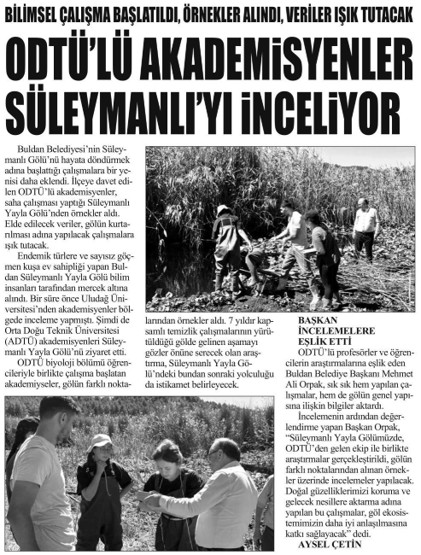
In September 2025, at the invitation of Buldan Municipality (Denizli), METU biologists and students carried out fieldwork at Süleymanlı Plateau Lake, which the municipality is working to restore after seven years of clean-up. The lake is home to endemic species and many migratory birds; the team took samples at different points of the lake, and the results will guide the next steps in restoring it. The mayor, who joined the fieldwork, said the study would help protect the lake's natural values for future generations.
https://basinda.metu.edu.tr/images/basin/2082206493_1.jpg

Marine climate and biodiversity research at the Institute of Marine Sciences
Several METU Institute of Marine Sciences projects running in 2025 study how to keep marine ecosystems healthy as the climate changes:
- ACTNOW (Horizon Europe, 2023–2026) improves understanding and prediction of how multiple stressors and cumulative human impacts affect marine biodiversity and the ecosystem functions people depend on.
- A TÜBİTAK 2247-A project (2022–2025) uses in-situ and ex-situ mesocosm experiments to show for the first time, at this scale, how extreme climate events change the structure, functioning and services of Eastern Mediterranean coastal ecosystems, to support their management.
- C-BLUES (Horizon Europe, 2024–2028) studies carbon storage in blue carbon ecosystems, including natural and farmed kelp, and works to have these ecosystems included in national greenhouse-gas inventories under the UN climate convention.
- The Erdemli Time Series (since 2017) monitors long-term changes in the physical environment and marine ecosystem of the Eastern Mediterranean, where the effects of climate change are expected to appear first.
- A METU-funded project (May 2024 – September 2026) uses artificial intelligence to identify how climate change and other human pressures drive changes in the Black Sea ecosystem and to produce climate projection scenarios for it.