
13.2.1. Low carbon energy tracking
Last Updated:
- English
- Türkçe
13.2.1. Low carbon energy tracking
METU measures the amount of low-carbon energy used across the university, together with its total energy use.
On-site renewable generation
METU generates solar electricity from photovoltaic systems on the Ayaslı Research Centre (75 kW), the Physics Department roof (5.5 kW, METU-GÜNAM test platform), the Demiray dormitories and the cafeteria building. The Energy Unit of the Department of Construction and Technical Works meters and records the electricity they produce; output from the 50 kW array is monitored in real time.
The largest of these are the rooftop solar power plants on the İsa Demiray, Faika Demiray and Refika Aksoy dormitories, with a total capacity of 810 kWe. In 2025 they generated 1,151,589 kWh (METU YITDB, 2025 Activity Report).
Their output has been tracked since they started operating in February 2023: 986,816 kWh in 2023, 1,127,030 kWh in 2024 (+14.2%) and 1,151,589 kWh in 2025 (+2.2%). Solar collectors also supply hot water in several buildings, including the Osman Yazıcı dormitory, and in 2025 METU applied to a Ministry of Environment, Urbanisation and Climate Change programme for solar power plants over two campus car parks (METU Energy Management Unit, Energy Efficiency Practices 2023–2026).
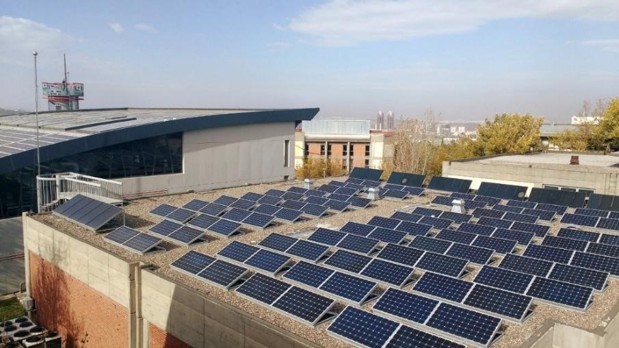
Rooftop solar panels on a campus building.
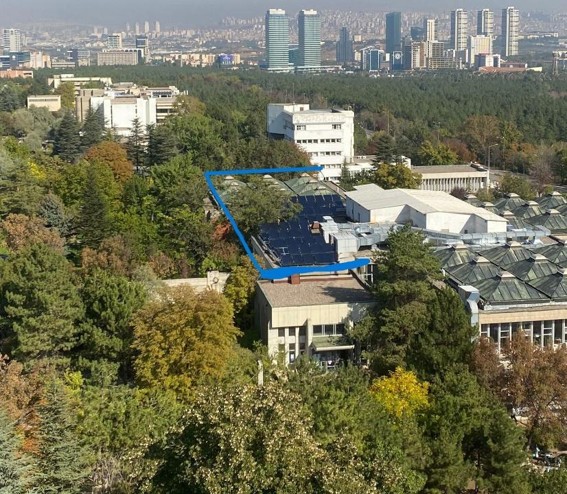
Aerial view of a solar-panelled roof on campus.
Measurement and results
Under its ISO 50001 Energy Management System, METU measures energy use across the whole campus. In 2023 the Energy Management Unit made an inventory of every energy-using device in about 160 campus buildings, and digital sub-meters and measuring devices were installed in more than 100 buildings so that electricity use can be monitored and reported building by building; a detailed energy audit report followed in 2024, and every building now has a named energy efficiency officer. The Energy Management System Manual (EnYS-EK-01, 16 April 2024) requires a monitoring and measurement plan that sets the location, parameter, frequency, method and person responsible for each energy measurement, defines energy performance indicators and an energy baseline, and has the Energy Management Unit report the key indicators to senior management every year. Consumption data are tracked continuously and reported every year to the Turkish Statistical Institute (TÜİK), the national Energy Efficiency Portal (ENVER) and the Council of Higher Education (YÖK). METU's Energy Management System Policy (EnYS-PL-01, 16 April 2024) commits the university to making use of renewable energy sources and to continually improving its energy performance (METU Energy Management Unit, Energy Efficiency Practices 2023–2026).
METU's Energy Management System has been certified to ISO 50001:2018 since 27 August 2024 by A'ND International Certification Services, a certification body accredited by TÜRKAK (certificate no. T50001/68/2024, valid until 26 August 2027). The certificate covers METU's education and research activities, its scientific, cultural, artistic and sports events, and the administrative services that support them. METU updated its Energy Management System documents and passed the certification body's surveillance audits in 2025 and 2026, so the certificate remains valid (METU YITDB, 2025 Activity Report; METU Energy Management Unit).
In 2025, METU bought 45,440,762 kWh of grid electricity and used 9,843,856 m³ of natural gas for heating. The rooftop solar plants on the dormitories supplied about 2.5% of the electricity METU used (1,151,589 kWh; METU YITDB, 2025 Activity Report).