12.2.4. Policy waste disposal—landfill policy
Last Updated:
- English
- Türkçe
12.2.4. Policy waste disposal—landfill policy
Middle East Technical University (METU) handles waste disposal in accordance with the Waste Directive of the Ministry of Environment and Urban Planning (https://www.resmigazete.gov.tr/eskiler/2015/04/20150402-2.htm). Through the METU Inorganic Waste and Recycling Policy (http://sustainablecampus.metu.edu.tr/en/policies) , METU ensures that inorganic or solid waste is collected and recycled to the extent possible, treating solid waste as a resource that contributes to the quality of life, inclusive and sustainable economy, and integrity of nature. The policy guides all official institutions, organizations, businesses, and individuals on campus to use a solid waste management system based on recycling, reusing, or avoiding waste generation.
1. Policy Mandates on Single-Use Materials & Digital Systems
- Ban on Disposable Materials: Disposable and non-environmentally friendly service materials made of plastic, aluminum, or foam cannot be used in canteens, cafeterias, restaurants, and buffets located on campus, nor sold in campus markets. Reusable service products are required for all academic and social events, and suppliers are expected to sell products in reusable or recyclable packaging.
- Paper-Reduction Initiatives: Staff carry out internal and external correspondence using the Electronic Document Management System (EBYS), and educational materials are shared via ODTUCLASS (Learning Management System) to ensure students receive a minimum number of printouts.
2. Campus Recycling Infrastructure & Waste Collection
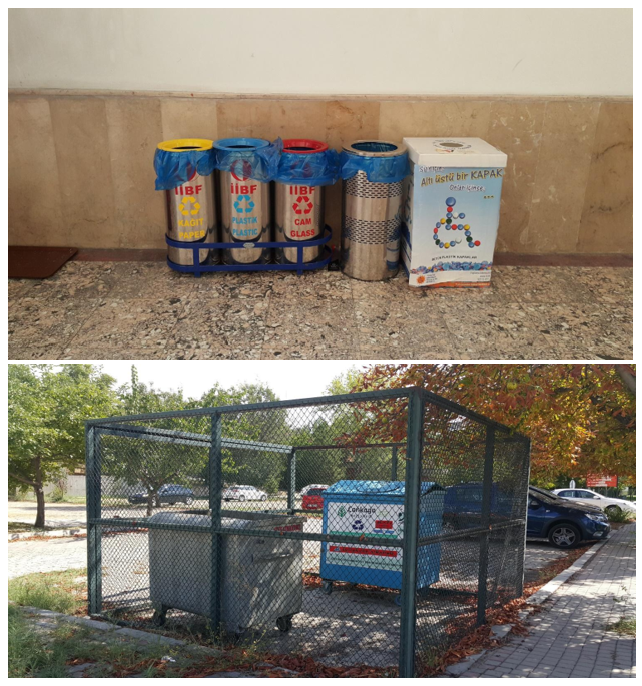
- Recycling Bins & Central Containers: All university buildings host at least one set of recycling bins. Recycled material is collected in a central container and delivered to Çankaya Municipality ([https://www.google.com/maps/d/u/0/viewer?mid=12cj77POs2gQLOXobpAr037Lks9... and its appointed company https://www.cankaya.bel.tr/pages/186/GERI-DONUSUM-HIZMETLERI/
3. Landfill Diversion: Refuse-Derived Fuel (RDF) & Organic Composting
- Refuse-Derived Fuel (RDF) Processing: Remaining waste is collected by ITC to be transformed into alternative fuel (Refuse Derived Fuel - RDF) to utilize its calorific value in industry (http://itcturkiye.com/en/municipal-waste-sorting-system/12024). This process limits residues that still have to be disposed of to an absolute minimum.
- Compost Machine Operations (March 29, 2024): Donated by the Ministry of Environment, Urbanization, and Climate Change, the composting machine was opened on March 29, 2024, with the participation of the Rector's Office. Raw vegetable and fruit waste, tea grounds, and coffee grounds are converted into fertilizer, preventing organic waste from going to landfill and increasing soil fertility across campus.
Applications